Polling Is an Art, Not a Science
What a 1984 disagreement between two pollsters says about the difference between having data and knowing what it means
Meet the Press dug out this clip last night about polling, featuring George Gallup Jr. and William Schneider. It seems like a comfortable enough discussion, but if you watch it closely, you’ll see that the two don’t actually agree.
One week before the 1984 Presidential election, both men were on Meet the Press to explain why every poll in the country put Reagan so far ahead of Mondale. The two agreed on the numbers, but they disagreed on what the numbers were, and what they meant.
Gallup, defending the discipline his father built, was focused on mechanism. When asked why different polling organizations produced different results on the same race, he explained:
“In order to compare two different polling organizations’ results, you have to have the same interviewing time, you have to have the same question order… and very importantly you have to use the same turnout scales.” 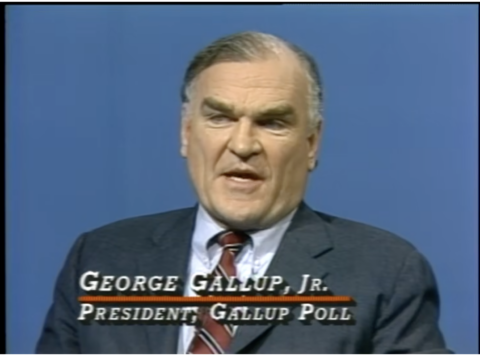
For him, polling is a science that includes controlled variables, a reproducible method, and a defensible result. Gallup can show his homework and prove how he arrived at his results.
Schneider pushed back when he spoke again:
“There’s no such thing as a fully authoritative poll. Polling is an art, not a science.”
Neither of them is wrong, but that’s what makes this exchange worth revisiting forty-two years later.
Two jobs, one coat
With polling, measurement is a science that includes sampling methodology, question design, turnout modeling, and interviewing windows that are held constant so the results can be compared to each other. The process is rigorous, testable, and worth defending, as Gallup argued. Without it, you have something like an educated guess, backed by a sample — but you don’t have reliable data.
Science alone doesn’t dictate what should be done with the data. It certainly doesn’t tell a campaign manager where to spend the budget, tell a network how to frame a headline, or tell a candidate whether a concerning number seven days from an election demands action. That’s where the art that Scheider talks about comes in. That art is judgment, and it’s applied to a number by someone who understands the method that produced it and the situation it’s supposed to inform.
It’s worth noting that Gallup wasn’t just a methodologist in that interview; he was also an artist. He referenced elections from 1948, 1968, and 1980, drawing parallels from history to predict the variables that could still impact the Presidential campaign in its final week. He wasn’t theorizing anything. What he was doing was interpreting based on pattern recognition and experience. He then layered that interpretation on top of a number that he was already pretty confident in.
Science delivers a trustworthy measurement, and art delivers a decision.
How this applies to marketing
Most research and insights functions are set up for delivery only. A study is fielded; a deck is built; topline findings are shared in a meeting — and then the organization expects the number to speak for itself. Guess what? It rarely does. That data, without interpretation, just sits there, technically accurate but functionally useless. It languishes while waiting for someone to guess what it means and how it might impact a key decision.
If “fragmentation starts on day one,” let’s accept that research isn’t just organizationally siloed from marketing and media. Measurement is siloed from the judgment needed to act on it. What use is rigorous data when no one can translate it into any kind of action?
AI-powered research tools don’t help with this; they just raise the stakes. Sure, faster, cheaper, more granular measurement is genuinely valuable, but more precise data doesn’t automatically produce better decisions. If anything, it raises the premium on the interpretive layer, because there’s more signal to sort through and fewer excuses for getting it wrong.
Both, but on purpose
The instinct to lean on one versus the other – that is, pure methodology with no advisory judgment, or pure advisory instinct with no methodological backbone — is understandable. They both comprise entire disciplines on their own.
Unfortunately, that’s exactly how you end up with either a platform full of statistically sound numbers nobody knows how to act on…or a team crackling with sharp instincts and brilliant ideas that can’t be defended to a CFO.
The point of building both of these under one roof is that they check and balance each other. Methodological vigor keeps the interpretation honest and grounded in something that’s actually been measured, not just assumed or intuited a la Don Draper. Advisory judgment keeps the methodology useful and moving toward an actual decision, not confined to a presentation that no one knows how to act on. Neither one is complete without the other and treating them as sequential hand-offs is exactly how the value gets lost between steps.
Back to the clip: Gallup had the science while Schneider argued for the art. The best answer to their forty-two-year-old disagreement isn’t to pick a side.
The best answer is noticing that the segment only worked because both of them were in the room.
—
Bright Mountain is built around that pairing: methodological vigor in gathering and modeling the data, paired with a long history of helping brands interpret what it means for the decision in front of them. The platform is science; the judgment is art. We believe that brands need both, in the same room, at the same time.
Latest Posts
The Marketing Laffer Curve: Why More Tools Produce Less Insight
Once upon a time, Arthur Laffer sketched a curve on a cocktail napkin, or so the story goes. The idea behind it…
Decision as a Service Isn’t a Technology Problem; It’s a Three-Legged Problem.
Insight Innovation Ventures recently published Decision as a Service: The Architecture That Changes Everything, naming a shift the insights industry…
What $300 Million Still Can’t Buy
A response to The New York Times' coverage of Simile On July 30, The New York Times introduced the world…